SEO vs Google Ads: Which Is Better for Canadian Small Businesses in 2026? | Omniora Inc.
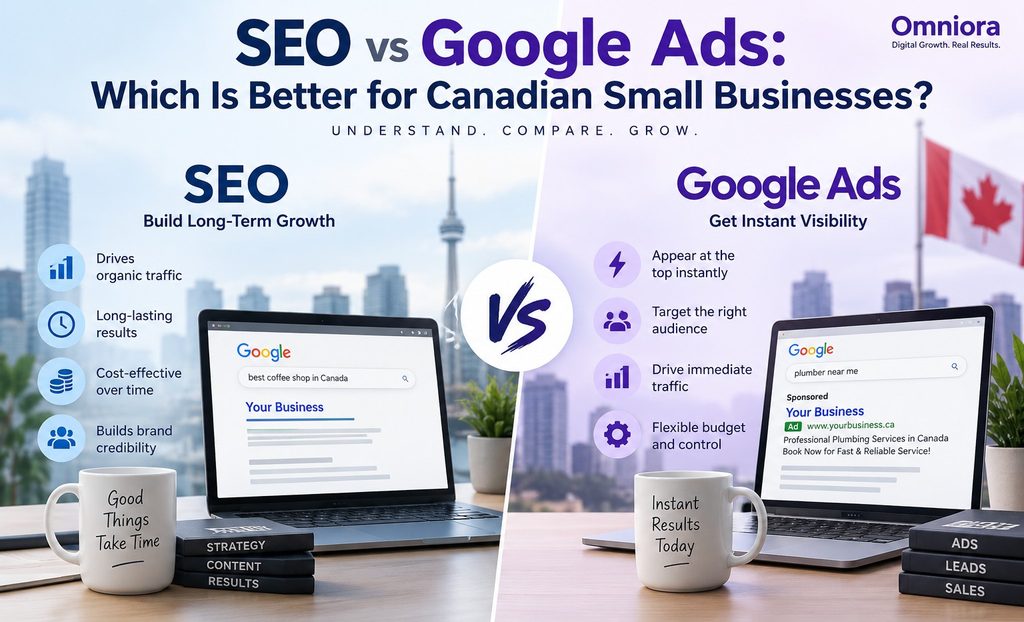
At Omniora Inc., we work across SEO, Google Ads, paid advertising, website development, and digital marketing for businesses looking to grow online. Our experience shows that SEO and Google Ads solve different marketing problems: SEO focuses on building organic search visibility over time, while Google Ads can put a business in front of relevant searchers through paid placements much faster.
For Canadian small businesses in 2026, there is no universal winner between SEO and Google Ads. SEO is generally suited to businesses building long-term organic visibility, while Google Ads can be useful when a business needs targeted traffic, leads, or sales sooner. For businesses with sufficient resources, using both can create a more complete search strategy.
SEO vs Google Ads: What Is the Difference?
SEO and Google Ads both help businesses appear when people search online, but they work in different ways.
SEO
Search Engine Optimization (SEO) involves improving your website and online presence so that pages can earn visibility in Google’s organic search results.
SEO can include:
- Keyword research
- Technical SEO
- On-page optimization
- Content creation
- Internal linking
- Local SEO
- Website improvements
- Authority building
- Search performance analysis
SEO does not require paying Google for every organic click.
However, SEO requires ongoing work and usually takes time to build meaningful visibility.
Google Ads
Google Ads is Google’s paid advertising platform.
Businesses can create campaigns around objectives such as:
- Website traffic
- Leads
- Sales
- Phone calls
- Store visits
Search campaigns can target people actively searching for relevant products or services. Advertisers set campaign budgets and targeting settings, and Google provides tools for measuring conversions and campaign performance.
SEO vs Google Ads: Quick Comparison
| Factor | SEO | Google Ads |
| Visibility | Organic | Paid |
| Speed | Usually slower | Can start quickly |
| Cost model | Investment in SEO work | Advertising spend + management |
| Long-term value | Can build lasting organic visibility | Traffic generally depends on active campaigns |
| Keyword targeting | Organic search strategy | Paid keyword targeting |
| Best for | Long-term visibility | Immediate/near-term demand capture |
| Content requirement | Important | Landing pages and ad assets matter |
| Budget control | SEO investment varies | Campaign budget can be set |
| Measurement | Traffic, rankings, conversions | Clicks, conversions, cost per lead, ROAS |
| Suitable for | Long-term growth | Time-sensitive or targeted campaigns |
Neither channel is automatically better for every business.
Is SEO Better Than Google Ads for Small Businesses?
The answer depends on what the business needs.
If the goal is to build organic visibility over the long term, SEO can be a strong investment.
If the goal is to reach potential customers quickly, Google Ads can be useful.
A small business should consider:
- How quickly leads are needed
- Available marketing budget
- Customer lifetime value
- Competition
- Search demand
- Website quality
- Conversion rate
- Geographic market
- Business seasonality
The key question is not “SEO or Google Ads?” but “What does my business need right now?”
When Should a Small Business Use SEO?
SEO is particularly relevant when a business wants to build a long-term search presence.
Consider prioritizing SEO when:
- You want consistent organic visibility
- Customers regularly search for your services
- You have time to build search rankings
- You want to reduce reliance on paid traffic over time
- You have useful expertise that can be turned into content
- You want to target multiple related search terms
- Your website needs technical and content improvements
Example
A Toronto accounting firm could create optimized service pages and useful content around relevant accounting searches.
Once those pages gain organic visibility, they can potentially continue attracting search traffic without paying Google for each organic click.
SEO creates a digital asset that can continue working after the initial optimization work.
When to Use Google Ads?
Google Ads can be useful when a business needs faster visibility or wants to capture existing search demand.
Consider Google Ads when:
- You need leads quickly
- You are launching a new service
- You have a seasonal promotion
- You are entering a competitive market
- Your website has commercial landing pages ready
- You want to test keyword demand
- You want to target specific geographic areas
- You have a measurable conversion goal
Google’s Search campaigns are specifically designed to reach people searching for products and services and can be optimized around goals such as sales, leads, or website traffic.
What Is PPC Advertising in Canada?
PPC advertising in Canada generally refers to paid advertising where businesses pay based on interactions such as clicks, depending on the campaign and platform.
Google Ads is one of the most widely used PPC channels.
With Google Ads, businesses can control important campaign settings such as:
- Budget
- Location
- Keywords
- Language
- Campaign objective
- Ad messaging
- Conversion goals
Google also provides conversion measurement so advertisers can track actions users take after interacting with advertisements.
How Does Google Ads for Small Business Work?
Google Ads for small business can be used to target people searching for relevant products and services.
For example, imagine a Canadian plumbing company targeting searches related to emergency plumbing.
A potential customer searches for a relevant service.
A properly targeted Search campaign can show an advertisement to that person.
The journey may look like:
Search → Ad → Landing Page → Call/Form → Lead
The important part is what happens after the click.
A Google Ads campaign cannot compensate indefinitely for a poor landing page, weak offer, or unclear conversion process.
How Quickly Can Google Ads Generate Traffic?
Google Ads can begin showing eligible advertisements after campaigns are created, approved, and launched.
This makes paid search useful when a business cannot wait months to build organic visibility.
However, traffic is not the same as profitable growth.
Campaign performance depends on factors such as:
- Search demand
- Keywords
- Competition
- Ad relevance
- Landing-page quality
- Budget
- Conversion rate
- Offer
- Geographic targeting
Google recommends defining campaign objectives and conversion goals when preparing campaigns.
How Long Does SEO Take?
SEO generally takes longer than launching a paid search campaign.
There is no universal SEO timeline because results depend on:
- Website authority
- Competition
- Technical condition
- Content quality
- Search intent
- Existing rankings
- Target keywords
- Location
- Consistency of optimization
A new website targeting competitive Canadian keywords may require substantially more work than an established website targeting lower-competition local searches.
SEO should be treated as a long-term growth strategy rather than a guaranteed quick-result channel.
Which Is More Cost-Effective: SEO or Google Ads?
This depends on how you define cost-effectiveness.
Google Ads requires an ongoing advertising budget. When campaigns are paused, the paid traffic generated by those campaigns generally stops.
SEO requires investment in strategy, content, technical work, and ongoing optimization. Successful organic rankings can continue generating traffic without paying Google for each organic click.
That does not mean SEO is free.
Businesses still need to invest in:
- SEO professionals
- Content
- Technical improvements
- Website development
- Research
- Digital PR or authority building
- Analytics
SEO may build longer-term organic value, while Google Ads provides a more direct way to buy targeted visibility.
SEO or PPC for Small Business: Which Should You Choose?
Use this simple decision framework.
| Your Situation | Consider |
| Need leads quickly | Google Ads |
| Building long-term visibility | SEO |
| Launching a new service | Google Ads + SEO |
| Strong search demand | SEO + Google Ads |
| Seasonal promotion | Google Ads |
| Local service business | Local SEO + Google Ads |
| New website | SEO foundation + targeted Ads |
| Competitive national market | SEO + carefully managed PPC |
| Limited budget | Prioritize the channel matching your immediate goal |
| Want diversified search visibility | SEO + Google Ads |
This is a decision framework, not a universal rule. The appropriate mix depends on the business and its economics.
Should a Small Business Use SEO or Google Ads?
A small business should look at its timeline, budget, customer journey, and search demand before deciding.
Choose SEO when:
Long-term visibility is the priority.
SEO can be particularly useful when customers repeatedly search for your services and you want to build organic visibility around those searches.
Choose Google Ads when:
Speed and targeted visibility are the priority.
Google Ads can help capture existing demand while an SEO strategy is still developing.
Consider both when:
You want short-term visibility and long-term organic growth.
Some Canadian businesses use paid search to capture demand now while building their organic search presence for the future.
Can SEO and Google Ads Work Together?
Yes.
SEO and Google Ads can support different parts of the same search strategy.
For example:
Google Ads → Immediate search visibility
SEO → Long-term organic visibility
A business can use Google Ads to generate traffic while SEO work improves important pages and builds organic visibility.
Paid campaigns can also provide useful information about:
- Search terms
- Ad messaging
- Landing pages
- Customer intent
- Geographic demand
- Conversion behavior
That information can help inform broader marketing decisions.
What Is the Best Strategy for a New Canadian Business?
A new business usually needs to establish its digital foundation before aggressively scaling either channel.
Start with:
Step 1: Build a Conversion-Ready Website
Make sure visitors can quickly understand:
- What you offer
- Who you serve
- Where you operate
- Why they should contact you
- How to take the next step
Step 2: Set Up Measurement
Track meaningful actions such as:
- Phone calls
- Forms
- Purchases
- Bookings
- Quote requests
Google Ads provides conversion measurement capabilities that can be used to track important actions from campaigns.
Step 3: Build the SEO Foundation
Work on:
- Technical SEO
- Keyword research
- Service pages
- Local SEO
- Helpful content
- Internal linking
Step 4: Use Paid Search Where Appropriate
If there is existing search demand and the economics make sense, use Google Ads to target relevant searches.
Step 5: Review the Data
Monitor:
- Cost per lead
- Conversion rate
- Organic traffic
- Paid traffic
- Sales
- Customer acquisition cost
Use data to decide where to increase or reduce investment.
SEO vs Google Ads for Local Canadian Businesses
Local businesses often have a particularly useful combination of organic and paid search opportunities.
For example:
- Dentist
- Plumber
- Electrician
- Lawyer
- Accountant
- Contractor
- Cleaning company
- Real estate professional
- Auto repair business
- Healthcare provider
A local business may use Local SEO + Google Ads to reach people searching for its services in specific geographic areas.
Google Ads allows advertisers to specify locations and other targeting settings, while local SEO focuses on organic and local search visibility.
What Should You Measure for SEO?
SEO should be measured using business-relevant metrics.
Important metrics can include:
- Organic traffic
- Organic leads
- Search visibility
- Keyword rankings
- Indexed pages
- Click-through rate
- Conversion rate
- Revenue from organic traffic
Avoid judging SEO only by the number of keywords ranking.
A ranking matters more when it attracts relevant visitors who can become customers.
What Should You Measure for Google Ads?
For PPC campaigns, important metrics can include:
- Impressions
- Clicks
- Click-through rate
- Cost per click
- Conversions
- Conversion rate
- Cost per conversion
- Conversion value
- Return on ad spend
Google provides campaign tools for measuring ad performance and making changes based on results.
The most important question:
How much does it cost to generate a customer—not simply how many clicks did you receive?
Common Mistakes Small Businesses Make
1. Choosing Ads Without Tracking Conversions
If you cannot determine which clicks generate meaningful actions, it becomes difficult to evaluate campaign performance.
2. Expecting SEO to Work Immediately
SEO usually requires time, content, technical improvements, and ongoing optimization.
3. Sending Paid Traffic to a Weak Website
A campaign may attract visitors, but a poor landing page can reduce the number of people who become leads.
4. Focusing Only on Rankings
High rankings do not automatically mean more sales.
5. Treating Google Ads as “Set and Forget”
Campaigns need monitoring and optimization.
6. Treating SEO as Free Traffic
SEO requires investment even though businesses do not pay Google for each organic click.
SEO vs Google Ads: A Practical 2026 Framework
For Canadian small businesses, consider this framework:
Need customers now?
Evaluate Google Ads first.
Building a business for the next several years?
Invest in SEO.
Running a seasonal promotion?
Google Ads may be useful for immediate visibility.
Have strong organic search potential?
Build SEO consistently.
Want both immediate and long-term search visibility?
Consider combining Google Ads and SEO.
The right choice depends on your business economics, search demand, competition, website quality, and timeline.
How Omniora Helps Canadian Small Businesses
At Omniora Inc., we provide digital marketing services designed around business objectives.
Our services include:
- SEO
- Google Ads
- PPC advertising
- Meta Ads
- Social media marketing
- Website development
- E-commerce
- AI solutions
- Content strategy
- Analytics and optimization
Our approach is to understand the business first and then determine which digital channels are appropriate.
SEO and Google Ads are tools. The strategy determines how those tools should be used.
Final Takeaway: SEO or Google Ads for Small Business?
There is no single answer to SEO vs Google Ads for every Canadian small business in 2026.
Choose SEO when your priority is building organic visibility and long-term search growth.
Consider Google Ads when you need faster, targeted visibility and have a campaign budget that supports profitable customer acquisition.
Consider using both when you want to capture current search demand while building organic visibility for the future.
The most useful decision starts with four questions:
- How quickly do I need customers?
- How much can I invest?
- How competitive are my target searches?
- Can I accurately measure leads and sales?
Answer those questions first, then choose the channel that fits your business.
Frequently Asked Questions
Is SEO better than Google Ads for a small business?
Neither is universally better. SEO is designed to build organic visibility over time, while Google Ads can provide faster paid visibility. The appropriate choice depends on the business’s goals, timeline, budget, competition, and search demand.
Should a small business use SEO or Google Ads?
A small business should consider its immediate needs. Google Ads can be useful when leads are needed quickly, while SEO can be valuable for building long-term organic visibility. Some businesses use both as part of a broader search strategy.
When should I use Google Ads?
Consider Google Ads when you need targeted visibility quickly, are launching a service, have a seasonal offer, or want to capture searches from people actively looking for your products or services. Google Search campaigns can be designed around goals such as sales, leads, or website traffic.
How long does SEO take compared with Google Ads?
Google Ads can begin generating eligible paid traffic after a campaign is approved and launched. SEO generally takes longer because organic visibility depends on factors such as website quality, competition, content, technical SEO, and search authority.
Is PPC advertising expensive in Canada?
PPC costs vary significantly by industry, keyword competition, location, targeting, campaign quality, and budget. There is no single Canada-wide PPC price. Businesses should evaluate cost per conversion and customer acquisition cost, not just cost per click.
Can I use SEO and Google Ads at the same time?
Yes. SEO and Google Ads can complement each other. Google Ads can provide paid visibility while SEO builds organic search visibility over time. The combination can diversify how a business reaches people through search.
One Comment